A Three-Volume Architecture for Understanding, Transforming, and Governing Co-Intelligent Ecosystems
The Dynamic Relationality Theory trilogy develops a new systems framework for the age of AI, co-intelligence, and ecosystemic transformation. Across three volumes, the trilogy moves from relational ontology, to organizational transformation grammar, to standards, evidence, and repair for intelligence-bearing systems.
At its core, the trilogy asks how humans, AI systems, organizations, institutions, infrastructures, and lived environments become dynamically entangled—and how these entanglements can be understood, designed, governed, and renewed without reducing human experience, value, or legitimacy to technical performance alone.
The trilogy is organized as a cumulative architecture:
Volume 1 establishes the ontology.
It explains why systems should not be understood as static entities, but as dynamic relational assemblages whose identities, capacities, and futures emerge through ongoing interaction.
Volume 2 develops the transformation grammar.
It translates relational ontology into organizational methods, blueprints, and design logics for creative transformation in co-intelligent ecosystems.
Volume 3 builds the standards layer.
It asks when AI-infused ecosystems can legitimately be considered intelligent, and what evidence, governance, contestability, and repair capacities such claims must carry.
Together, the three books provide a theoretical, methodological, and practical foundation for navigating complex transformations of intelligence in an interconnected world.
Vol. 1
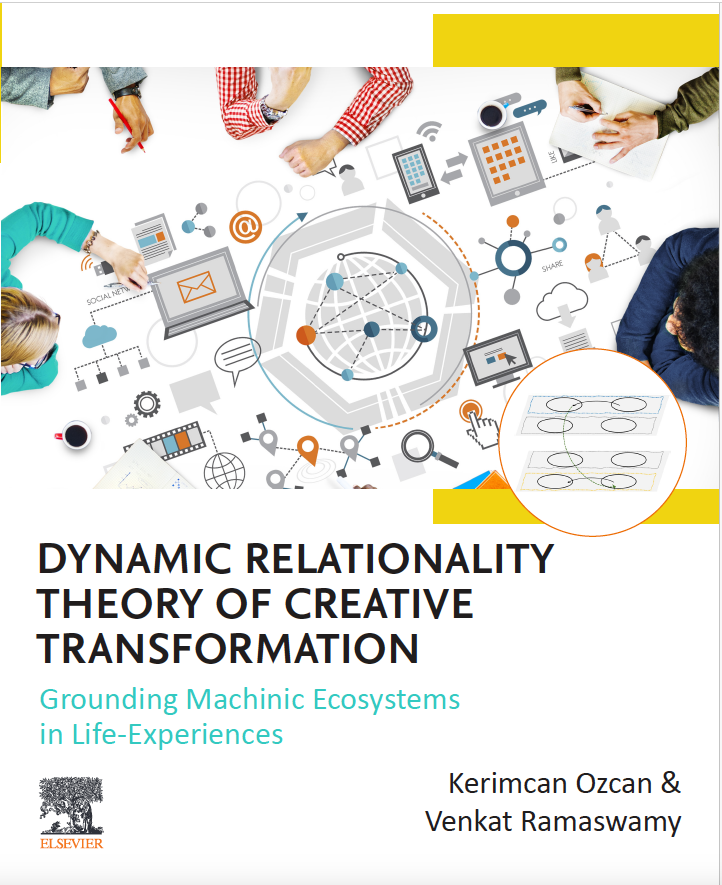
Dynamic Relationality Theory of Creative Transformation
Grounding Machinic Ecosystems in Life-Experiences
Dynamic Relationality Theory of Creative Transformation introduces the foundational ontology of the trilogy. It argues that systems are not fixed structures composed of isolated entities, but dynamic relational assemblages whose forms, meanings, and capacities emerge through continuous processes of actualization, counter-actualization, deterritorialization, reterritorialization, and creative becoming.
Drawing on philosophy, systems science, category theory, differential topology, gauge theory, and interdisciplinary studies, the book develops Dynamic Relationality Theory as an ethico-epistem-ontological framework for understanding machinic ecosystems grounded in life-experiences. It introduces Machinic Life-Experience Ecosystems (MLXEs) as a way to understand how human experience, machinic processes, symbolic worlds, and systemic flows co-evolve.
As Volume 1 of the trilogy, this book provides the relational ontology and conceptual foundation for the two subsequent volumes. It establishes the deep theoretical ground for understanding creative transformation in a world shaped by human-AI co-creation, digitalization, platforms, and complex ecosystem dynamics.
Trilogy role: Relational ontology and foundational theory.
Vol. 2
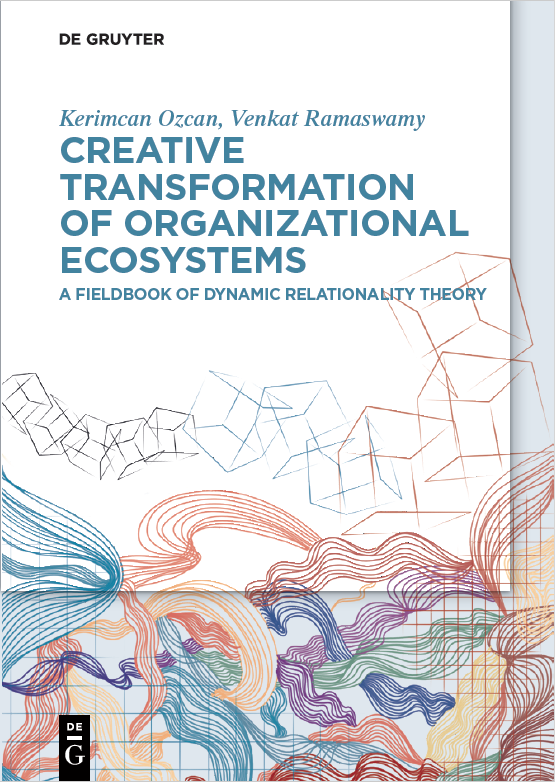
Creative Transformation of Organizational Ecosystems
A Fieldbook of Dynamic Relationality Theory
Creative Transformation of Organizational Ecosystems translates Dynamic Relationality Theory into an organizational transformation grammar. It shows how organizations can be understood and redesigned as co-intelligent ecosystems, where human agency, AI capabilities, stakeholder experience, operational flows, and institutional structures continuously shape one another.
The book develops practical and conceptual tools for diagnosing and transforming organizational ecosystems. It uses category theory, sheaf theory, gauge theory, diagrammatic reasoning, morphogenesis, and design-based innovation to model how organizations align global strategies with local practices, coordinate stakeholder ecosystems, and adapt to emergent complexity.
As Volume 2 of the trilogy, CTOE moves from relational ontology to intervention. It provides transformation blueprints, organizational examples, and strategic design methods for leaders, researchers, consultants, and system architects seeking to build adaptive, ethical, and scalable co-intelligent ecosystems.
Trilogy role: Organizational transformation grammar and intervention architecture.
Vol. 3
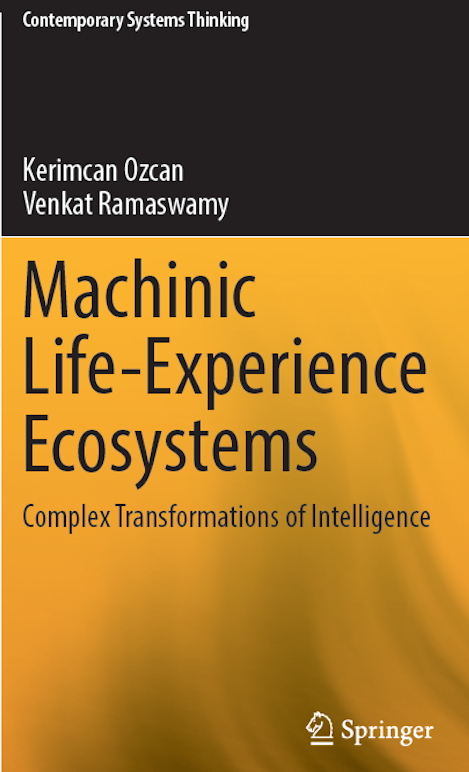
Machinic Life-Experience Ecosystems
Complex Transformations of Intelligence
Machinic Life-Experience Ecosystems develops the standards layer of the trilogy. It asks what must be true before an AI-infused ecosystem can legitimately be said to have become more intelligent rather than merely more automated, optimized, or controlled.
The book reframes intelligence as a trajectory quality of coupled systems under constraint and perturbation. Intelligence is not treated as computational capability alone, but as the capacity of a system to remain coherent, accountable, contestable, legitimate, and repairable as it acts and evolves. The Machinic Life-Experience Ecosystem becomes the fundamental unit for analyzing, designing, comparing, and governing such transformations.
Drawing on assemblage theory, category theory, sheaf theory, gauge theory, network theory, complexity science, valuation studies, and practice theory, the book develops concepts such as Tokenized Dynamic Intelligence, Global Super-Intelligence as repairable polycentric coherence, the REAL governance framework, scenario runs, obstruction diagnosis, metric deformation tests, and the MLXE Operating System.
As Volume 3 of the trilogy, MLXE translates relational ontology and organizational transformation grammar into standards, evidence, assurance, perturbation, governance, and repair. It provides a framework for building intelligent ecosystems that create value while remaining governable beyond automation.
Trilogy role: Standards, evidence, governance, and repair layer for co-intelligence.
The Trilogy Arc
The DRT trilogy can be read as a cumulative movement:
DRT asks: What is the relational nature of creative transformation?
CTOE asks: How can organizations be redesigned as co-intelligent ecosystems?
MLXE asks: When can transformed ecosystems legitimately be called intelligent, and how can that intelligence remain governable, contestable, and repairable?
Together, the trilogy offers a comprehensive architecture for understanding the complex transformations of intelligence now unfolding across human life, AI systems, organizations, institutions, platforms, and society.